
Table of Contents
ToggleWhy Google Advertising for Small Business Hotels Is More Powerful Than Traditional Hotel Advertising Services
Google Ads for a hotel business in Ahmedabad is more effective than traditional hotel advertising because it targets travelers at the exact moment they are searching for accommodation — not before or after. You only pay when someone clicks your ad, making every rupee accountable and every impression intentional.
Traditional hotel advertising — newspaper listings, travel magazine features, outdoor hoardings, and even OTA listing fees — operates on a broadcast model. You pay to be seen by a large audience, most of whom have no intention of booking a hotel in Ahmedabad anytime soon. The cost is fixed regardless of results, the targeting is approximate at best, and measuring actual impact on bookings is nearly impossible. For a small hotel with a limited marketing budget, this is a deeply inefficient way to compete.
Google Ads flips this model entirely. When a traveler types ‘hotel near Ahmedabad airport’ or ‘budget hotel in Navrangpura’ into Google, they are in active booking mode — they have a trip planned, a budget in mind, and they are ready to make a decision. Your Google ad appears at that precise moment, in front of that precise person. If they click and book, you pay for that click. If they do not click, you pay nothing. This intent-based targeting is why Google advertising consistently delivers better cost-per-booking than any traditional advertising channel for hotels of any size.
The accountability of Google Ads is another critical advantage. Traditional hotel advertising services charge upfront with vague promises about reach and visibility. Google Ads shows you exactly how many people saw your ad, how many clicked, how many went on to visit your booking page, and — when set up correctly — how many completed a reservation. This transparency allows even a small hotel owner to make intelligent, data-driven decisions about where to put their next ₹1,000 of marketing budget.
For independent hotels in Ahmedabad competing against OTAs like MakeMyTrip and Booking.com — who spend crores on Google advertising — this level of precision is not just helpful, it is the only realistic path to competing effectively. A targeted Google Ads campaign for a boutique hotel in Prahlad Nagar, focused on the right keywords and the right audience, can absolutely outperform a generic OTA listing that buries you on page four. The playing field is not equal, but it is far more level than traditional hotel advertising ever allowed.
Understanding Google Ads Marketing Agency vs. DIY: What Works Better for Your Hotel Business in Ahmedabad?
For most small hotel businesses in Ahmedabad, working with a Google Ads marketing agency delivers better results than DIY — especially in the first six to twelve months. However, agency partnerships work best when the hotel owner understands the basics, so they can evaluate performance, ask the right questions, and avoid being oversold on services they do not need.
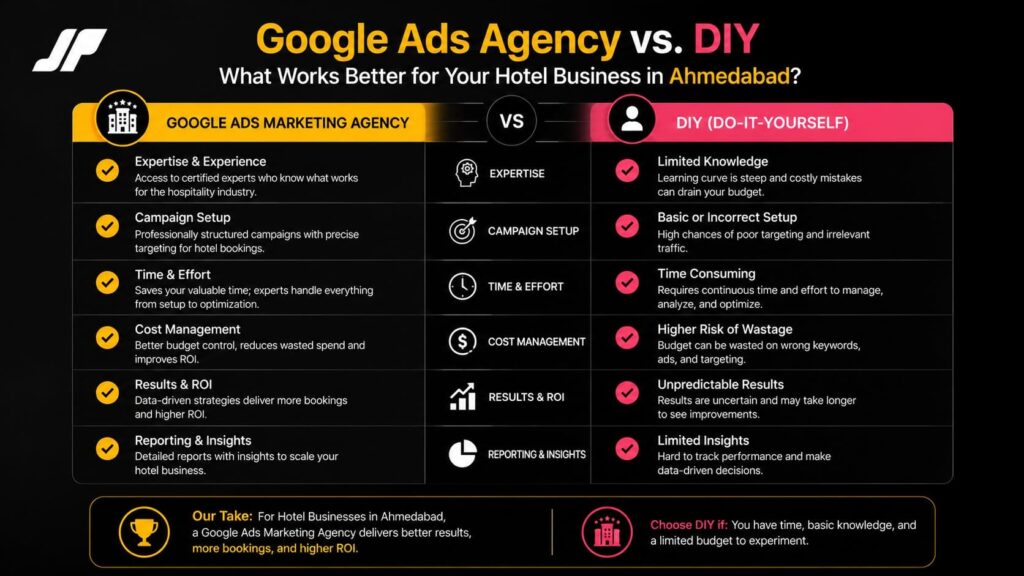
his is one of the most practical questions any independent hotel owner faces when starting with Google advertising. The honest answer depends on three things: your available time, your comfort with digital tools, and how much monthly budget you are working with. Both approaches have real merit — and both have genuine risks.
Choosing DIY Google Ads for hotel management gives you full controland eliminates agency fees, which typically range from ₹5,000 to ₹15,000 per month for small accounts. If you are willing to invest 8–10 hours learning Google Ads fundamentals — through Google’s free Skillshop courses — and another 5–6 hours per month managing and optimising your campaigns, self-management is viable. The risk is that mistakes in campaign setup can drain your budget quickly. A single misapplied broad match keyword, a missing negative keyword list, or an incorrectly set bidding strategy can spend your entire monthly budget in days without a single booking to show for it.
A Google Ads marketing agency brings immediate expertise — they know how to structure hotel campaigns, which keywords convert for accommodation businesses, and how to set up conversion tracking correctly from day one. For a hotel spending ₹10,000 to ₹15,000 per month on ads, a good agency recovers their fee through efficiency improvements within the first few months. The risk on the agency side is accountability — some agencies prioritise high ad spend (because their fee is often a percentage of spend) over actual booking outcomes.
Agency vs. DIY: Quick Decision Framework
Factor | DIY Management | Google Ads Agency |
Setup Time | High — weeks to learn and configure | Fast — days to launch |
Monthly Cost | ₹0 management fee | ₹5,000–₹15,000 typical fee |
Error Risk | High — especially in first 3 months | Low — if agency is experienced |
Optimisation Speed | Slow — learning curve | Fast — established processes |
Transparency | Complete — you see everything | Varies — demand full access |
Best For | Budget under ₹8,000/month, tech-savvy owners | Budget ₹10,000+/month, time-poor owners |
Whichever route you choose, insist on full ownership of your Google Ads account. Your account, your historical data, and your conversion history should be yours — not held by an agency in their manager account with restricted access. This is non-negotiable.
Setting Up Your First google business advertising for hotel Without Wasting Your Budget
To set up your first Google business advertising campaign for a hotel without wasting budget, start with Search campaigns only, use exact and phrase match keywords, build a negative keyword list from day one, link to a dedicated landing page — not your homepage — and set a manual CPC bid strategy until you have at least 30–50 conversions to feed Smart Bidding.
The most common and expensive mistake hotel owners make when launching their first Google Ads campaign without wasting the budget is rushing the setup. Google’s campaign creation wizard is designed to get you spending quickly — it defaults to settings that maximise Google’s revenue, not yours. Understanding which defaults to override before you spend a rupee is the single highest-value thing you can do as a first-time advertiser.
Begin by creating a dedicated Google Ads account linked to your hotel’s Google Business Profile. When creating your first campaign, select ‘Search’ as the campaign type and deselect the ‘Search Network’ and ‘Display Network’ expansion options that Google checks by default. These expansions dilute your budget by showing ads in contexts that rarely lead to hotel bookings. Choose ‘Website visits’ or ‘Lead generation’ as your campaign goal, and set your geographic targeting to cover Ahmedabad plus a radius that captures your most common traveler origins — typically other major Gujarat cities and nearby metro areas.
Your campaign structure should follow a simple but effective pattern: one campaign per major theme, with tightly focused ad groups inside. For a small hotel, start with three ad groups — branded searches (your hotel name), location-based searches (hotel in [your area]), and amenity-based searches (hotel with parking near [landmark]). Each ad group should contain five to ten closely related keywords and its own tailored ad copy. This tight structure improves your Quality Score, which directly lowers your cost-per-click.
Before your campaign goes live, build your negative keyword list. At minimum, exclude terms like ‘free,’ ‘jobs,’ ‘career,’ ‘internship,’ ‘review,’ ‘complaint,’ ‘photos,’ and competitor hotel names you do not want to pay to appear for. A thorough negative keyword list on day one prevents budget waste from the first impression. Learn more about how negative keywords protect your hotel advertising budget long-term.
Keyword Strategy for Hotel Marketing Services: How to Outbid Starwood Hotels and Resorts Without Their Budget
Small hotels can outperform large chains on Google Ads not by outbidding them on broad terms, but by targeting high-intent, hyper-specific keywords where competition is low. Long-tail location-specific phrases, occasion-based queries, and amenity-focused searches convert better and cost far less than generic terms dominated by major hotel groups.
Trying to rank for ‘hotel in Ahmedabad’ puts you in direct bidding competition with MakeMyTrip, Booking.com, OYO, and potentially the marketing machines of international hotel chains. These competitors have budgets that can sustain costs of ₹150–₹300 per click on high-volume terms. On a small budget, chasing those keywords is a losing strategy before you have even started.
The alternative is specificity — and it is more powerful than most hotel owners realise. Consider the difference between a traveler searching ‘hotel in Ahmedabad’ versus ‘hotel near Ahmedabad railway station with parking’ or ‘business hotel in Prahladnagar Ahmedabad.’ The second and third searches are from people who know exactly what they want, are much closer to booking, and face far fewer advertisers competing for their click. Cost-per-click for these long-tail terms can be 60–80% lower than generic terms, while conversion rates are often two to three times higher.
Build your keyword strategy in layers. Start with your core local keywords: ‘[hotel type] in [your area of Ahmedabad]’ — for example, ‘budget hotel in Navrangpura’ or ‘family hotel near Sardar Patel Stadium.’ Then add occasion-based keywords: ‘hotel for wedding guests in Ahmedabad,’ ‘hotel near GIFT City for business travel,’ ‘couple-friendly hotel in Ahmedabad.’ Finally, add amenity keywords: ‘hotel with free breakfast Ahmedabad,’ ‘pet-friendly hotel Ahmedabad,’ ‘hotel with rooftop restaurant Ahmedabad.’ Each layer targets a specific type of traveler at a specific stage of their decision process.
Use phrase match and exact match keyword types for budget-controlled campaigns. Broad match can be introduced later when you have enough conversion data to use Smart Bidding effectively. Always run a search terms report weekly in the early months — this shows you the actual queries triggering your ads, revealing both valuable keywords to add and wasteful terms to negative out. This practice alone typically reduces wasted spend by 20–30% in the first two months.
Google Ads Campaign Types That Work Best for Digital Marketing for Hotels
For digital marketing for hotels on a limited budget, Search campaigns deliver the best immediate ROI because they capture active booking intent. Display and YouTube campaigns work for brand awareness but require larger budgets to be effective. Performance Max campaigns can work well for hotels with at least 50 monthly conversions and high-quality creative assets.
Google Ads for a hotel business in ahmedabad offers multiple campaign types, and not all of them are equally appropriate for a small hotel in Ahmedabad. Choosing the wrong campaign type is a fast way to burn budget without bookings. Here is an honest breakdown of what each type delivers for hotel businesses at different budget levels.
Search campaigns are the foundation and should be your first and primary investment. They place text ads in Google search results when users type relevant queries. Because Search captures existing demand — people already looking for a hotel — it is the highest-intent campaign type available. For a budget of ₹5,000 to ₹15,000 per month, Search campaigns should receive at least 80% of your allocation. Everything else is secondary until your Search campaigns are profitable and optimised.
Google Hotel Ads (now part of the broader travel vertical) are specifically designed for accommodation businesses and deserve special attention. These appear on Google Search, Google Maps, and Google Travel when users look for hotels in a specific location. They show your real-time rates, availability, photos, and reviews alongside your ad — making them highly conversion-friendly. To use Hotel Ads, you need to connect a booking engine or property management system that provides live rate feeds. If your hotel has direct online booking capability, Hotel Ads should be your second priority after Search campaigns.
Display campaigns — banner ads across Google’s partner websites — and YouTube ads are better suited for brand awareness than direct bookings. They can be effective for retargeting users who visited your website but did not book, reminding them of your property as they browse other sites. However, retargeting requires a minimum audience size to function, typically meaning at least 1,000 monthly website visitors. Performance Max campaigns, which automate placement across all Google channels, are best introduced once you have established conversion data and approved creative assets — not as a starting point for a new account.
Campaign Type Recommendation by Monthly Budget
Monthly Budget | Recommended Campaign Types | Expected Outcome |
₹5,000 – ₹8,000 | Search only (exact & phrase match) | Direct booking intent, tight control |
₹8,000 – ₹15,000 | Search + Google Hotel Ads | Bookings + rate visibility on Maps |
₹15,000 – ₹30,000 | Search + Hotel Ads + Display Retargeting | Full funnel — capture & re-engage |
₹30,000+ | All above + Performance Max | Maximum reach with automation assist |
How to Use Lead Generation Ads to Drive Direct Bookings for Your Hotel
Lead generation ads for hotels work by capturing traveler contact details — name, phone, email, travel dates — directly within Google’s platform, without requiring the user to visit your website. This is particularly powerful for hotels that want to convert inquiries into direct phone bookings, bypassing OTA commission fees entirely.
Most hotel owners think of Google Ads purely as a traffic-driving tool — run an ad, send clicks to your website, hope visitors book online. But lead generation as a campaign objective unlocks a different and often more effective pathway, particularly for independent hotels that may not have a fully optimised online booking system or whose guests prefer human contact before committing to a reservation.
Google’s lead form extensions allow you to attach a contact form directly to your Search ad. When a traveler clicks the form icon on your ad, a pre-filled form appears without leaving Google — asking for their name, phone number, email address, and any custom questions you configure (such as check-in date or number of guests). The traveler submits the form in seconds, and you receive the lead immediately via email notification or CRM integration. This frictionless process typically yields higher completion rates than sending users to a website booking form.
For Ahmedabad hotels targeting domestic business travelers or wedding guests — segments that commonly prefer to confirm details over the phone before booking — lead form ads are particularly well-suited. A corporate traveler searching for ‘business hotel near SG Highway Ahmedabad’ who submits a lead form at 9 AM expects a callback within the hour. Hotels that respond within 15–30 minutes consistently report lead-to-booking conversion rates of 40–60% from these inquiries, compared to 10–20% from unattended website form submissions.
Set up lead form ads by navigating to your campaign’s ad extensions (now called assets in Google Ads), selecting ‘Lead form,’ and configuring your form fields and headline. Download leads directly from Google Ads or connect to a CRM via webhook. Pair your lead form with a strong call to action — ‘Get Your Best Rate Today’ or ‘Check Availability — Response in 30 Minutes’ — to maximise submission rates. Learn more about connecting Google Ads lead forms to your hotel’s booking workflow.
Hospitality Marketing on Google Ads: Writing Ad Copy That Converts Travelers Into Guests
Effective hotel ad copy on Google Ads combines a specific location reference, a standout differentiator, a clear value statement, and a direct call to action — all within the tight character limits of Search ads. Generic hotel ads blend into the results page; specific, benefit-led copy stops the right traveler and earns the click.
Writing ad copy for hotel marketing on Google Ads is both a craft and a science. You have 30 characters for each headline (up to 15) and 90 characters for each description (up to 4) in a Responsive Search Ad. Google dynamically combines your headlines and descriptions to find the best-performing combinations — but only if you provide strong, varied inputs. Many hotel owners write one or two similar headlines and call it done. This approach misses the optimisation opportunity entirely.
Your headline strategy should cover three angles: location specificity, value proposition, and urgency or offer. For location, use ‘Hotel in [your area], Ahmedabad’ as one headline — this matches what the searcher typed and signals immediate relevance. For value proposition, lead with your strongest differentiator: ‘Free Airport Pickup Included,’ ‘Rooftop Restaurant with City Views,’ ‘Business-Ready Rooms from ₹2,499.’ For urgency or offer, try ‘Book Direct — Save 15% vs OTAs’ or ‘Limited Rooms Available This Weekend.’
Descriptions should expand on your headline value proposition and close with a clear call to action. Avoid generic phrases like ‘We offer great service and comfortable rooms’ — every hotel says this and none of it is believable without evidence. Instead, be specific: ‘All rooms include 24-hour AC, high-speed Wi-Fi, complimentary breakfast, and same-day laundry. Direct bookings include free early check-in on request. Call to confirm availability.’ Specificity creates credibility. Credibility creates clicks.
Use ad assets (formerly extensions) aggressively — they expand your ad’s visual footprint and provide additional information at no extra cost. Sitelinks can point to your room types, photo gallery, local area guide, and dining page. Callout assets can highlight ‘Free Cancellation,’ ‘Instant Booking Confirmation,’ and ‘Best Price Guarantee.’ A call asset adds your phone number directly to the ad, enabling mobile users to call without visiting your site. A fully asset-equipped ad can occupy significantly more screen space than a bare text ad, improving click-through rates by 15–30%.
How International Hotels Group and Rosewood Hotel and Resorts Use Google Ads — And What Small Hotels Can Steal From Them
Large hotel groups like IHG and Rosewood invest heavily in brand protection campaigns, loyalty program promotion, and destination-level content marketing on Google Ads. Small hotels can adopt their most effective tactics — branded keyword protection, location-specific landing pages, and rate transparency messaging — without the multi-crore budgets, by applying them at a focused local scale.
Studying how international hotel groups approach Google Ads is genuinely instructive for independent hotel owners — not because you should try to replicate their scale, but because their strategies reveal what works in hospitality marketing at the highest level of sophistication. Stripping those strategies down to their principles and applying them locally is one of the smartest competitive moves a small hotel can make.
The first tactic worth adopting is branded keyword protection. Large hotel chains consistently bid on their own brand names in Google Ads — even though they rank organically for those terms. Why? Because OTAs frequently bid on brand names, and without a brand campaign, a traveler searching ‘Rosewood Hotel Ahmedabad’ might click a Booking.com ad and book through the OTA, costing the hotel a 15–25% commission that could have been avoided with a direct booking. Even for small independent hotels, bidding on your own hotel name costs almost nothing (Quality Scores for branded keywords are typically 9–10, making cost-per-click extremely low) and protects your most motivated, highest-intent audience.
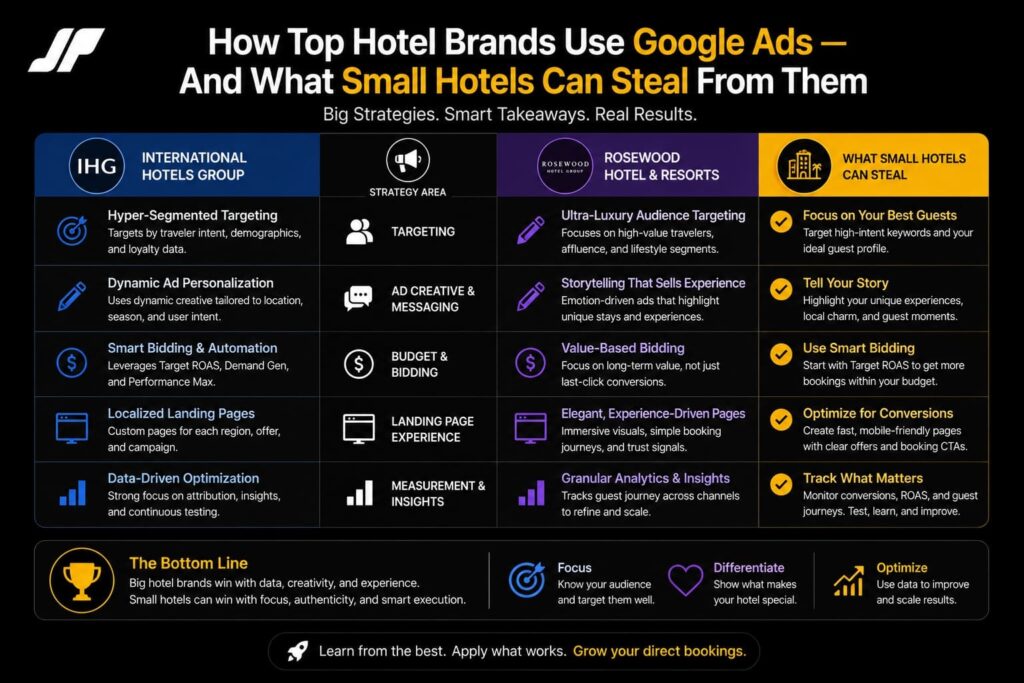
The second tactic is destination-specific landing pages. International hotel groups create dedicated landing pages for ‘Hotels near [airport],’ ‘Business Hotels in [city],’ ‘Hotels for [event or occasion]’ — matching the specific search queries their ads target. Small hotels can implement this same approach with one or two well-built pages on their website. A page specifically about ‘Hotel near Ahmedabad Airport with Free Shuttle’ that matches the ad targeting that term will dramatically outperform a generic homepage in conversion rate.
The third takeaway is rate messaging. IHG and Marriott both run ‘Best Price Guarantee’ messaging prominently in their Google Ads, directly addressing the traveler’s concern about whether they are getting the best deal. As a small hotel, matching this message — ‘Book Direct for Our Lowest Guaranteed Rate’ — removes one of the biggest psychological barriers to direct booking and positions your direct channel favourably against OTAs without requiring a single rupee of discount.
Budgeting Smart: How to Run Google Ads Marketing for Your Hotel Business With ₹5,000–₹15,000/Month
Running Google Ads for a hotel business on ₹5,000 to ₹15,000 per month is entirely viable when the budget is focused exclusively on high-intent Search campaigns, hyper-specific local keywords, and a strong negative keyword list. At this budget level, every rupee must work — which means zero spend on Display, no broad match, and daily performance checks in the first month.
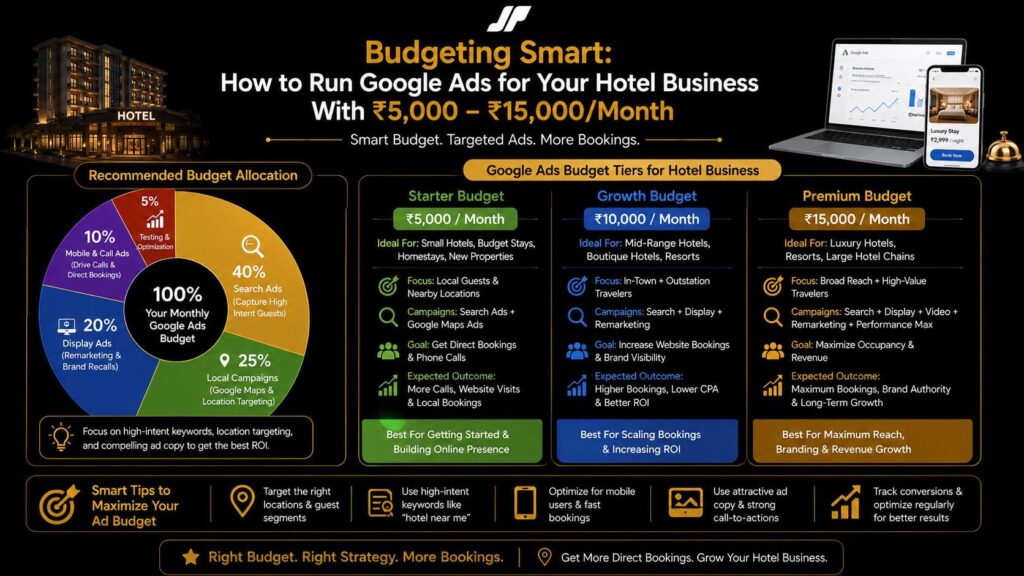
A common misconception about Google Ads is that small budgets cannot produce meaningful results in competitive categories like hospitality. In practice, a smartly structured ₹10,000/month Google Ads account consistently outperforms a poorly managed ₹50,000/month account. Budget size matters far less than budget discipline — and discipline begins with allocation.
At ₹5,000 per month, your daily budget is approximately ₹165. At average CPCs of ₹20–₹40 for targeted long-tail hotel keywords in Ahmedabad, this translates to roughly 4–8 clicks per day, or 120–240 clicks per month. With a landing page conversion rate of 5–8% (realistic for a well-optimised hotel booking page), that is 6–19 booking inquiries per month from your ad spend alone. If even 30–40% of those convert to actual reservations at an average room rate of ₹2,500–₹4,000 per night, the return on a ₹5,000 investment is clear.
To maximise a small budget, implement ad scheduling — running ads only during hours when your target audience is most likely to search and book. For leisure travelers, evenings and weekends typically perform better. For business travelers, weekday mornings and afternoons are most productive. Pausing ads during low-conversion hours can extend your effective budget by 20–30% without reducing your reach among your most valuable audience segments.
Geotargeting is equally important. Rather than targeting all of India, focus your budget on cities with the highest intent for Ahmedabad travel: Surat, Vadodara, Rajkot, and Mumbai for leisure travelers; Delhi and Bangalore for business travelers attending conferences or GIFT City meetings. Adjust bids higher for these high-performing locations using bid modifiers, and reduce or exclude lower-performing regions. This precision ensures your ₹5,000–₹15,000 goes where it has the highest probability of generating a booking, not where it simply generates impressions.
Tracking ROI From Your Hotel Marketing Agency Campaigns: Google Analytics + Conversion Setup Explained
To accurately track ROI from hotel Google Ads campaigns, you must set up conversion tracking for the specific actions that indicate booking intent — phone calls, booking form submissions, WhatsApp clicks, and completed online reservations. Without this setup, you are running ads blind, with no way to distinguish what is producing bookings from what is producing clicks.
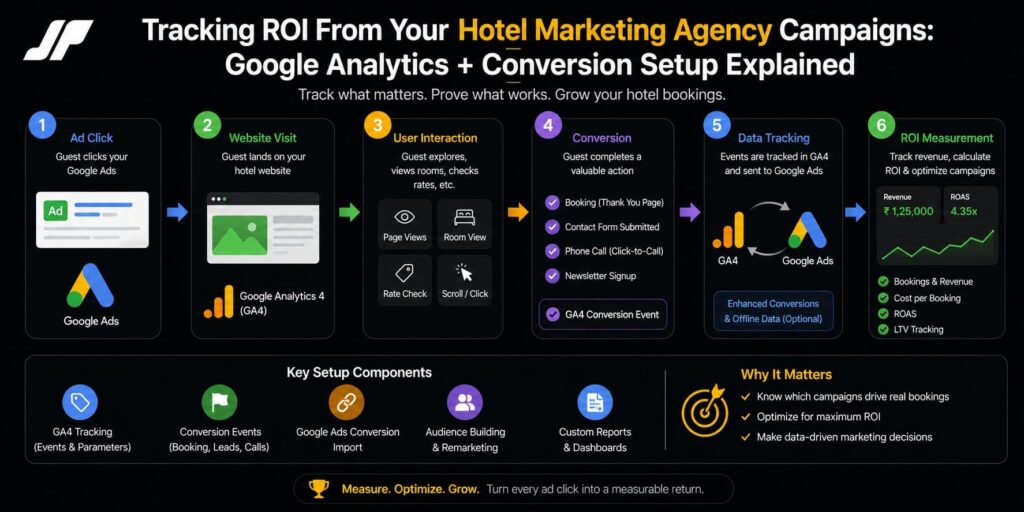
This is the section most hotel owners and even some marketing agencies skip or implement poorly — and it is the most important. Running Google Ads without proper conversion tracking is the equivalent of running a print ad campaign without knowing which newspaper your guests saw it in. You might be getting results, or you might be wasting money. Without data, you cannot know the difference, and you certainly cannot improve.
Start with Google Ads conversion tracking for phone calls. Hotel bookings frequently begin with a phone call — the traveler clicks your ad, sees your number in the call asset, and calls directly. Google’s call conversion tracking assigns a dynamic Google forwarding number to your ads, allowing Google to record when a call is made and how long it lasts (calls over 60 seconds are typically considered meaningful). This data feeds back into your campaign, enabling Smart Bidding strategies to optimise toward callers rather than just clickers.
Next, set up Google Analytics 4 (GA4) and link it to your Google Ads account. In GA4, create custom conversion events for the actions most indicative of booking intent: ‘booking_form_submit’ (when someone completes your inquiry form), ‘whatsapp_click’ (if you use WhatsApp for booking inquiries), ‘availability_check’ (when someone searches availability on your booking engine), and ‘booking_confirmed’ (the final thank-you page after a completed reservation). Each of these events tells a different part of the customer journey story.
Import your GA4 conversion events into Google Ads and set appropriate values for each. If your average booking is worth ₹7,500, assign that value to a ‘booking_confirmed’ event. Assign lower values to earlier-funnel actions — ₹1,500 for a form submission, ₹750 for an availability check. This value-based tracking allows Google’s algorithms to optimise your bids toward the users most likely to complete the full booking journey, not just those most likely to click. Review your conversion data weekly in the early months and use it to identify which campaigns, keywords, and ad copies are producing actual bookings — then scale what works and eliminate what does not. This data discipline is what turns a small hotel advertising budget from a cost centre into a predictable booking engine.
About the Author – Janvi Patel
Janvi Patel is a Digital Marketing Consultant in Ahmedabad specializing in SEO, Google Ads, social media marketing, web strategy, and performance-driven digital campaigns. She helps local businesses improve online visibility, generate qualified leads, and grow their brand through practical marketing strategies, data-backed insights, and result-oriented digital solutions.
FAQs
Is Google Ads really worth it for a small independent hotel in Ahmedabad?
Yes, absolutely. Google Ads targets travelers at the exact moment they are searching for accommodation — meaning every rupee you spend reaches someone already planning a trip. Unlike newspaper ads or OTA listings, you only pay when someone clicks. Even on a budget of ₹5,000 to ₹15,000 per month, a well-structured campaign focused on long-tail local keywords can generate 6–19 booking inquiries monthly with measurable, data-backed results.
How much should a small hotel in Ahmedabad spend on Google Ads per month?
A starting budget of ₹5,000 to ₹15,000 per month is entirely viable for small hotels. At ₹5,000/month, you get roughly 120–240 targeted clicks monthly, which can produce 6–19 booking inquiries depending on your landing page quality. The key is not the budget size but budget discipline — spending exclusively on high-intent Search campaigns, using exact and phrase match keywords, and maintaining a strong negative keyword list from day one.
Should I hire a Google Ads agency or manage hotel ads myself?
It depends on your time and budget. If you are spending under ₹8,000/month and are comfortable with digital tools, self-management is viable after completing Google’s free Skillshop training. For budgets of ₹10,000 and above, a good agency typically recovers its fee through efficiency improvements within the first few months. Whichever route you choose, always insist on full ownership of your Google Ads account — your data must remain yours, not locked inside an agency’s manager account.
What keywords should a hotel in Ahmedabad target in Google Ads?
Avoid broad terms like “hotel in Ahmedabad” where you compete with MakeMyTrip and OYO on massive budgets. Instead, focus on three layers: local keywords like “budget hotel in Navrangpura,” occasion-based keywords like “hotel for wedding guests in Ahmedabad,” and amenity keywords like “hotel with free breakfast Ahmedabad.” These long-tail phrases cost 60–80% less per click, attract buyers much closer to booking, and face far fewer competing advertisers.
What is the best Google Ads campaign type for a hotel with a limited budget?
Search campaigns should be your first and primary investment, receiving at least 80% of your budget. They capture travelers already actively searching for accommodation, making them the highest-intent campaign type available. Once your Search campaigns are profitable, add Google Hotel Ads to show real-time rates on Google Maps and Google Travel. Display and Performance Max campaigns are better introduced later, once you have established conversion data and consistent monthly bookings to guide automation.
How do lead generation ads work for hotel bookings on Google?
Lead generation ads attach a contact form directly to your Google Search ad. When a traveler clicks, a pre-filled form appears — asking for name, phone, email, and check-in details — without ever leaving Google. This frictionless process produces higher completion rates than sending users to a website form. For Ahmedabad hotels targeting business travelers or wedding guests who prefer phone confirmation, responding to these leads within 15–30 minutes consistently delivers booking conversion rates of 40–60%.
How do I track whether my Google Ads are actually generating hotel bookings?
Set up conversion tracking for every action that signals booking intent — phone calls via Google’s call forwarding number, booking form submissions, WhatsApp clicks, and completed online reservations. Link Google Analytics 4 (GA4) to your Google Ads account and create custom conversion events for each action. Assign monetary values to each event based on your average booking value, so Google’s algorithm can optimise bids toward users most likely to complete a full reservation, not just those most likely to click.
How can a small hotel compete against large hotel chains on Google Ads?
You cannot outspend them, but you can outsmart them. Large chains dominate broad search terms — so avoid those entirely. Focus on hyper-specific long-tail keywords where big brands rarely bid. Protect your own brand name with a low-cost branded campaign so OTAs cannot intercept your most motivated searchers. Build destination-specific landing pages that match your ad targeting exactly. Add “Book Direct for Our Lowest Guaranteed Rate” messaging to remove the psychological barrier of booking away from OTAs — a tactic borrowed directly from IHG and Marriott, applied at your local scale.