
PPC marketing strategies for manufacturing business and Google ad for manufecturing business are becoming essential for industrial companies looking to generate qualified B2B leads and increase sales in competitive markets.
Ahmedabad is one of India’s most dynamic manufacturing hubs, home to thousands of industrial units spanning plastics, textiles, electronics, chemicals, pharmaceuticals, and engineering goods. Yet most manufacturers here rely almost entirely on word-of-mouth, trade fairs, or outdated portals to find buyers. In 2026, that is no longer enough. Pay Per Click advertising — better known as PPC — is transforming how manufacturing companies in Ahmedabad find qualified buyers, generate B2B leads, and grow export pipelines.This guide breaks down everything a manufacturing business owner needs to know about PPC digital marketing, from the first campaign to a full lead generation pipeline.
Table of Contents
ToggleHow PPC Advertising Works Differently for Industrial Manufacturing Companies vs. Other Businesses
PPC advertising for industrial manufacturing companies works differently from consumer-focused businesses because the buying cycle is longer, purchase decisions involve multiple stakeholders, order values are high, and search intent is highly specific. Manufacturing PPC campaigns must be engineered for B2B buyer behavior, not impulse purchases.
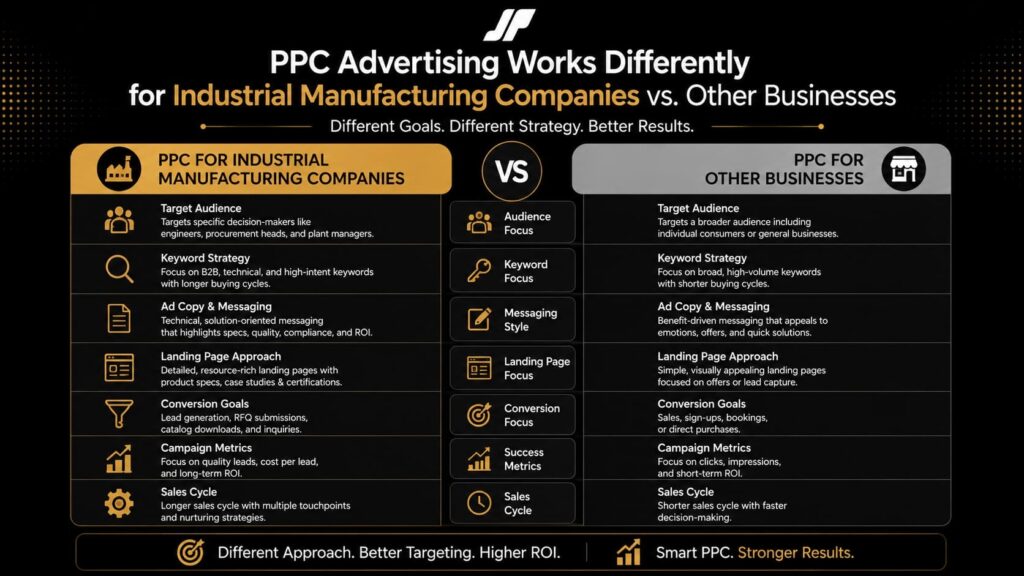
When a clothing retailer runs PPC ads, they target individuals making fast, emotion-driven buying decisions. A well-designed landing page and a discount code can convert a visitor in minutes. Manufacturing PPC operates in an entirely different reality. A buyer sourcing plastic granules, industrial valves, or custom PCBs is conducting careful evaluation over days or weeks. They compare multiple suppliers, assess quality certifications (like ISO or BIS), evaluate lead times, and often involve a purchase committee before finalizing a vendor.
This means manufacturing PPC campaigns must be structured to capture intent at different stages of the buying journey. Top-funnel keywords like ‘plastic raw material suppliers India’ attract buyers in research mode who need educational content — a product catalogue, a capability overview, or a case study. Bottom-funnel keywords like ‘HDPE granules supplier Ahmedabad minimum order 500kg’ signal buyers ready to request quotes. Mixing these without separate ad groups and landing pages wastes budget on the wrong audience.
Another critical difference is the role of remarketing. Because industrial buyers take longer to decide, a single ad click rarely converts to a lead immediately. Remarketing campaigns — which re-display your ads to visitors who browsed your website but did not inquire — are essential for manufacturing PPC. They keep your brand visible during the evaluation period, increasing the likelihood that when the buyer is ready to contact a supplier, they contact you. Learn more about B2B remarketing strategies to understand how to implement this effectively for your manufacturing business.
Setting Up Your First Pay Per Click Campaign for a Manufacturing Business in Ahmedabad
To set up your first PPC campaign as a manufacturing business in Ahmedabad, define your target buyer persona, research high-intent keywords specific to your product and geography, create separate ad groups for each product category, build dedicated landing pages for each campaign, set a conservative daily budget, and track conversions from day one.
The foundation of a successful PPC campaign is clarity on who you are trying to reach. Before opening Google Ads, answer these questions: Who are your ideal buyers — traders, distributors, OEM manufacturers, or direct end-users? What geographies do you serve — Ahmedabad only, pan-Gujarat, pan-India, or export markets? What specific products or capabilities do you want to promote first? These answers shape every subsequent decision in your campaign setup.
Once your buyer persona is clear, keyword research becomes the most important task. For an Ahmedabad-based plastic manufacturer, relevant keywords might include ‘plastic injection moulding company Ahmedabad,’ ‘polypropylene sheet supplier Gujarat,’ or ‘custom plastic parts manufacturer India.’ Each of these reflects a different buyer intent and should be placed in a separate ad group with its own tailored ad copy and landing page. Grouping all keywords into a single ad group — a common beginner mistake — dilutes relevance and inflates costs.
Your landing page is where conversions happen,and it is where most first-time manufacturing advertisers fail. Sending all PPC traffic to your homepage is ineffective. Each ad group needs a dedicated landing page that matches the ad’s promise, showcases the specific product with specifications, highlights certifications and quality standards, includes a short inquiry form requesting basic details like product required, quantity, and contact information, and displays trust signals such as years in business, client logos, and certifications. A well-built landing page can double or triple conversion rates versus a generic homepage.
Start your first campaign with a conservative daily budget— even INR 500 to INR 1,000 per day for a focused product and geography can generate meaningful data within two weeks. Use broad match modified and phrase match keywords initially to discover which search terms buyers actually use, then shift budget toward the highest-performing terms.
PPC Digital Marketing Strategies That Work for Plastic Manufacturing Company Owners
The plastic manufacturing sector in Ahmedabad — concentrated in industrial zones like Vatva GIDC, Naroda, and Odhav — is one of the most active manufacturing segments in Gujarat. Plastic manufacturers serve a diverse buyer base: packaging companies, automotive OEMs, FMCG brands, construction firms, and agricultural equipment makers. Each of these buyer segments searches differently, which requires a segmented PPC approach.
The most effective PPC strategy for plastic manufacturers starts with product-specific campaigns.Rather than running one generic campaign for ‘plastic manufacturer Ahmedabad,’ create separate campaigns for each product line — plastic granules, injection moulded parts, PVC pipes, polythene bags, or custom plastic components. This segmentation ensures your ad copy, keywords, and landing pages are tightly aligned with what each buyer is actually looking for, improving both Quality Score and conversion rates.
For plastic manufacturers targeting B2B clients, Google Search Ads on high-intent keywords perform best. Terms like ‘custom injection moulding supplier Ahmedabad,’ ‘LDPE film manufacturer Gujarat,’ or ‘food-grade plastic container manufacturer India’ attract procurement managers with genuine sourcing needs. Pair these with a landing page that leads with your production capacity, material certifications (FDA, RoHS, ISO), and minimum order quantities — the three things industrial plastic buyers need to know before they inquire.
Display advertising on Google’s Display Network can complement search campaigns effectively for plastic manufacturers. Banner ads placed on industry portals, trade association websites, and related manufacturing publications keep your brand visible to buyers even when they are not actively searching. Combine display ads with remarketing to recapture visitors who viewed your product pages but did not submit an inquiry — a strategy that typically delivers 30% to 50% lower cost-per-lead than cold acquisition campaigns alone.
How Electronic Manufacturing Companies Use PPC Advertising to Generate High-Quality B2B Leads
Electronic manufacturing is one of the fastest-growing segments in Ahmedabad and broader Gujarat, driven by India’s push for domestic electronics production under national incentive programs. PCB manufacturers, electronic component suppliers, LED lighting manufacturers, and industrial electronics OEMs are increasingly competing for buyers online — and PPC is becoming the primary acquisition channel for high-quality B2B leads.
The key to effective PPC for electronic manufacturers is specificity. Generic keywords like ‘electronics manufacturer’ attract the wrong traffic and inflate costs without generating qualified leads. Highly specific keywords — ‘SMT PCB assembly manufacturer Ahmedabad,’ ‘custom LED driver manufacturer India,’ ‘industrial control panel supplier Gujarat’ — attract procurement engineers and purchase managers with defined sourcing requirements. These buyers are further along in the decision process and far more likely to convert to a quality lead.
Electronic manufacturers should also leverage LinkedIn Ads as a complementary PPC channel. LinkedIn allows targeting by job title (Purchase Manager, Electronics Engineer, R&D Head), company size, and industry — making it ideal for reaching decision-makers at OEMs, EMS companies, and systems integrators who source electronic components and assemblies. While LinkedIn CPC is higher than Google, the lead quality for B2B electronics sourcing is often superior because you are reaching verified professionals in relevant roles.
A proven strategy for electronic manufacturers is using Google Search Ads to drive traffic to a gated content offer — such as a product capability document, a quality certification package, or a case study showing how you served a major OEM. When buyers download this content, you capture their contact details as a warm lead for your sales team to follow up with. This approach generates leads that are already educated about your capabilities, shortening the sales cycle significantly.
Google Ads vs. Meta Ads: Best Pay Per Click Advertising Platforms for Clothing Manufacturers in Ahmedabad
Ahmedabad’s textile and clothing manufacturing sector — spanning areas like Narol, Rakhial, and the broader Surat-Ahmedabad garment corridor — presents a unique PPC challenge because buyer personas vary dramatically. Clothing manufacturers may serve B2B buyers (wholesale distributors, retail chain procurement teams, export buyers) and in some cases B2C buyers (direct online consumers). Choosing the right platform depends entirely on which buyer you are targeting.
Criteria | Google Ads | Meta Ads (Facebook / Instagram) |
Best For | B2B buyers actively searching for suppliers | Brand awareness & B2C / D2C clothing buyers |
Buyer Intent | High — buyer is actively searching | Low to medium — passive browsing |
Targeting Method | Keywords + location + device | Demographics, interests, lookalike audiences |
Ad Formats | Text search, shopping, display | Image, video, carousel, stories, reels |
Cost Per Click (Avg.) | INR 20–80 for manufacturing terms | INR 5–30 depending on audience |
Lead Quality for B2B | Very High | Medium |
Best Use Case | Export buyers, wholesale distributors | Fashion retail buyers, D2C brand building |
Remarketing | Yes — Google Display Network | Yes — Facebook Pixel audience targeting |
For clothing manufacturers targeting wholesale distributors, retail chain buyers, or export customers, Google Ads is the clear primary platform. A buyer sourcing ‘ethnic wear manufacturer Ahmedabad minimum order 500 pieces’ or ‘readymade garment exporter Gujarat’ is using Google with high purchase intent. Your ad needs to appear here, linked to a landing page showing your manufacturing capacity, fabric capabilities, MOQs, and compliance certifications.
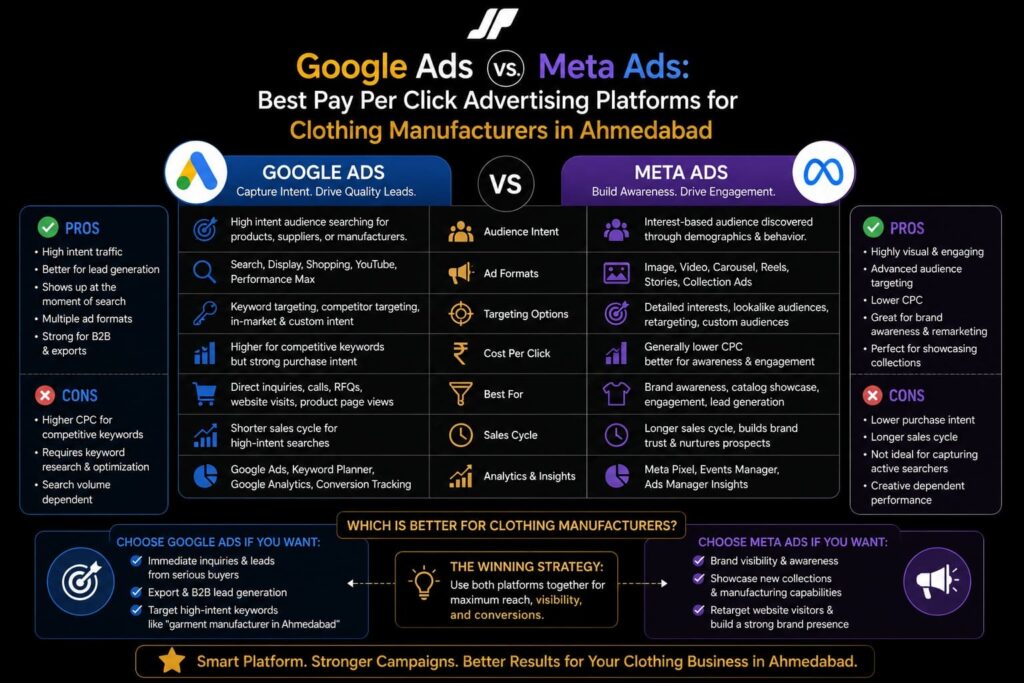
Meta Ads (Facebook and Instagram) serve a different but complementary purpose for clothing manufacturers. If you are building a brand or targeting retail buyers who discover new suppliers through social media, Instagram’s visual format is powerful for showcasing product quality, design range, and craftsmanship. Meta’s lookalike audience feature allows you to upload a list of your existing B2B clients and target new buyers with similar profiles — an effective prospecting strategy. Use both platforms together: Google for active search intent, Meta for brand building and awareness.
Keyword Research for Manufacturing Companies: How to Find Buyers Before Your Competitors Do
Effective keyword research for manufacturing companies means identifying the exact search terms industrial buyers use at each stage of their sourcing journey — from category exploration to supplier comparison to final vendor selection — and building campaigns around those terms before competitors discover them.
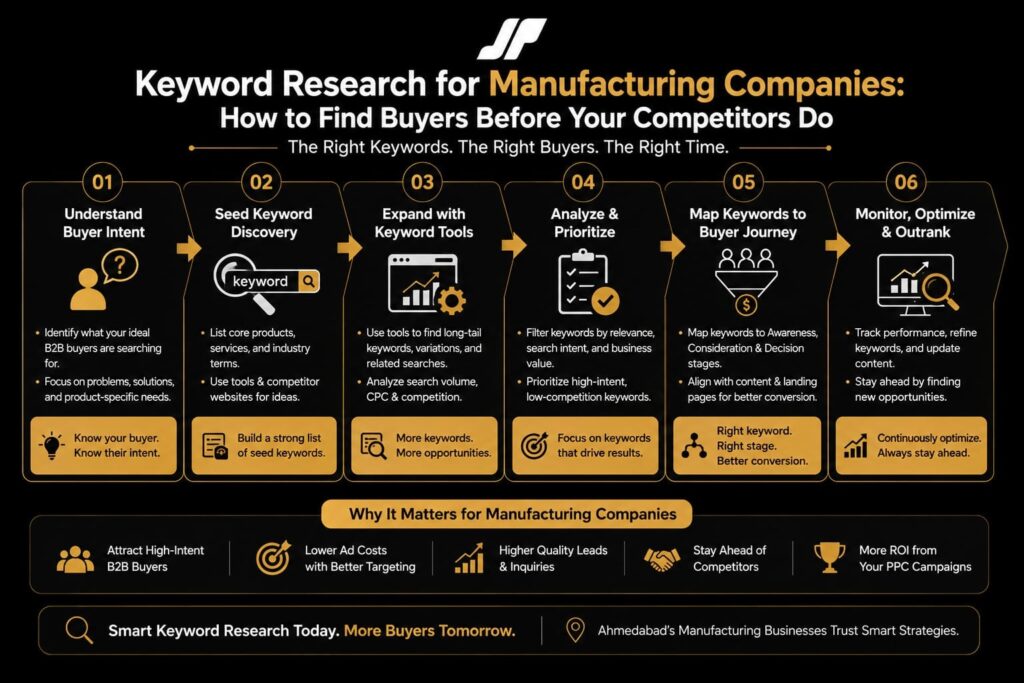
Most manufacturing businesses approach keyword research incorrectly. They target broad, high-competition terms like ‘manufacturer in Ahmedabad’ that are too generic to attract qualified buyers and too expensive to bid on profitably. Effective manufacturing keyword research goes three levels deeper: product-specific terms (what exactly is being sourced), specification-specific terms (grade, size, material, certifications), and geography-specific terms (city, state, region, or export destination).
Start your research with Google Keyword Planner, which is available free within Google Ads. Enter your core product names and analyze which related terms have meaningful search volume. For a Gujarat-based chemical manufacturer, this might reveal that ‘industrial solvent supplier Gujarat’ has 500 searches per month while ‘chemical manufacturer Ahmedabad’ has 1,200 — but the former converts better because it reflects a buyer who has already decided on the product and is now sourcing a supplier.
Competitor keyword analysis is equally valuable. Tools like SEMrush or Ahrefs allow you to see which keywords your top competitors are bidding on. If a competing plastic manufacturer in Vatva GIDC is running ads on ‘HDPE pipe manufacturer Gujarat’ and generating leads, that is a validated keyword worth bidding on. You can also identify keyword gaps — high-intent terms your competitors have missed — and capture that traffic exclusively.
Long-tail keywords deserve special attention in manufacturing PPC. A keyword like ‘food-grade stainless steel valve manufacturer Ahmedabad ISO certified’ may have very low search volume — perhaps 50 searches per month — but the buyer using that search is highly specific about what they need. These searches convert at dramatically higher rates than generic terms, and because fewer advertisers bid on them, the cost per click is significantly lower. Building a large portfolio of 200 to 500 targeted long-tail keywords often outperforms a campaign built on 10 to 20 broad terms.
How to Build a PPC Campaign That Gets Your Business Into the List of Manufacturing Companies Buyers Search First
The most coveted position in manufacturing PPC is appearing consistently at the top of search results for your core buyer queries — not just once, but every time a relevant buyer searches. Achieving this requires a combination of high Quality Scores, competitive bidding strategy, compelling ad copy, and optimized landing pages working together as a system.
Quality Score is Google’s rating of your ad’s relevance and expected performance, scored from 1 to 10. A high Quality Score (7 or above) means Google considers your ad highly relevant to the searcher’s intent — and rewards you with better ad placement at a lower cost per click. You improve Quality Score by ensuring tight alignment between your keyword, the ad copy that uses that keyword, and the landing page that fulfills the ad’s promise. For example, if you bid on ‘industrial gearbox manufacturer Ahmedabad,’ your ad headline should say ‘Industrial Gearbox Manufacturer — Ahmedabad | ISO Certified | Request Quote’ and your landing page should specifically feature your gearbox products with specifications and an inquiry form.
Ad copy for manufacturing businesses must communicate three things immediately: what you make, why you are trustworthy, and what the buyer should do next. Include relevant differentiators in your headlines — ’25+ Years Manufacturing Experience,’ ‘Export to 30+ Countries,’ ‘ISO 9001 Certified,’ or ‘Same-Day Quote Available’ — that address the concerns industrial buyers have when evaluating a new supplier. Use all available ad extensions: call extensions (so buyers can call directly from the search page), sitelink extensions (linking to specific product pages, certifications, and your about page), and structured snippets (listing your product range).
Bidding strategy should evolve as your campaign matures. Start with manual CPC bidding to maintain control while you gather data. After accumulating at least 30 to 50 conversions, switch to Target CPA (Cost Per Acquisition) bidding, which uses Google’s machine learning to optimize bids automatically for the conversion rate patterns your campaign has established. This transition typically results in 20% to 40% improvement in lead volume at the same or lower cost.
Budget Breakdown: How Much Should a Manufacturing Business Spend on PPC Digital Marketing?
A manufacturing business in Ahmedabad should start PPC with a monthly budget of INR 15,000 to INR 30,000for local and regional campaigns, scaling to INR 50,000 to INR 1,50,000 per month as campaigns prove ROI. The right budget depends on your product category, competition level, target geography, and expected deal value.
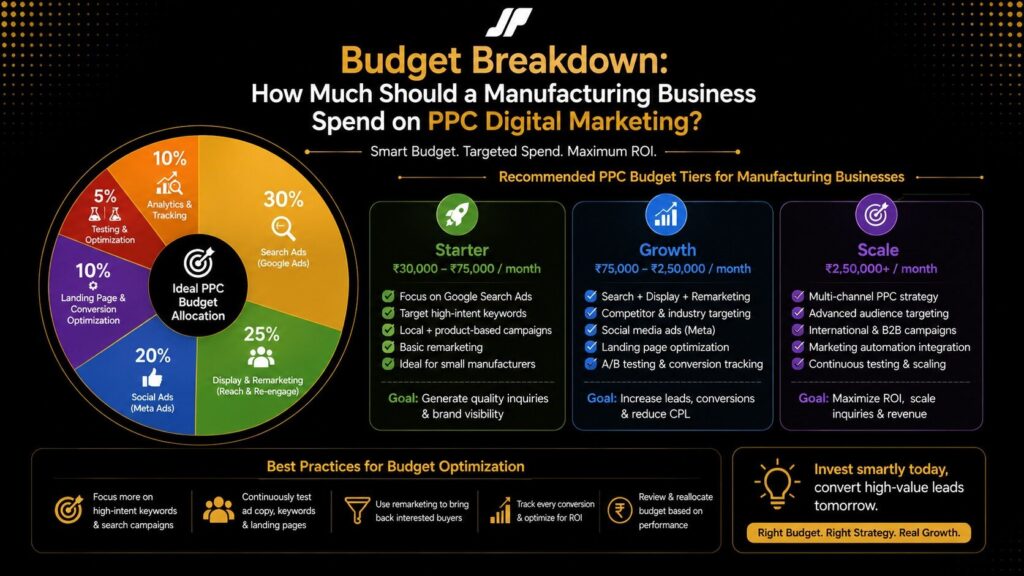
Budget planning for manufacturing PPC requires working backwards from your business economics. If you manufacture industrial equipment with an average deal value of INR 5 lakhs and a profit margin of 20%, even a single deal generated by PPC delivers INR 1 lakh in profit. If your campaign generates three to five qualified leads per month and converts one into a customer, an INR 30,000 monthly ad spend delivers exceptional return on investment. Understanding this math is what separates businesses that scale PPC confidently from those that abandon it after one month.
Business Type | Recommended Monthly PPC Budget | Target Geography | Expected Leads/Month |
Small-scale manufacturer (local supply) | INR 10,000 – 20,000 | Ahmedabad / Gujarat | 10–20 leads |
Mid-size manufacturer (pan-India) | INR 30,000 – 75,000 | Pan-India B2B | 25–60 leads |
Export-focused manufacturer | INR 75,000 – 1,50,000 | India + International | 30–80 leads |
Large industrial manufacturer | INR 1,50,000+ | Multi-market | Custom targets |
Distribution of your PPC budget matters as much as the total amount. As a general guideline for manufacturing businesses, allocate approximately 70% of your budget to Google Search Ads (the highest-intent channel), 15% to remarketing campaigns (recapturing visitors who did not convert), and 15% to experimental channels such as LinkedIn Ads or Google Display. This allocation ensures the majority of your spending targets buyers with demonstrated intent while maintaining brand visibility throughout the consideration period.
Never set a budget based solely on what you can afford without considering your competitive landscape. Use Google’s Keyword Planner to check average CPCs for your target keywords. If your core keywords cost INR 40 per click and you need 500 clicks to generate 10 inquiries (a 2% conversion rate), your monthly budget needs to be at least INR 20,000 to generate meaningful data. Underspending in a competitive market means your ads rarely show, data accumulates too slowly to optimize, and you draw incorrect conclusions about PPC’s effectiveness.
Tracking and Scaling Your Pay Per Click Campaign: From First Lead to Full Pipeline
Tracking and scaling a manufacturing PPC campaign requires setting up conversion tracking for every lead source, analyzing performance data weekly, eliminating wasted spend on non-converting keywords, increasing budgets on proven performers, and progressively expanding to new products, geographies, and audience segments as ROI is established.
The single most important technical step in PPC management is conversion tracking setup — and it is the step most manufacturing businesses skip entirely. Conversion tracking connects ad clicks to business outcomes: form submissions, phone calls, catalogue download requests, and WhatsApp inquiries. Without this data, you are essentially driving blind, spending budget without knowing which ads, keywords, and landing pages are actually generating leads. Install Google Ads conversion tracking on your website, set up call tracking using a dedicated phone number, and if you use WhatsApp for business inquiries, implement WhatsApp click tracking as well.
The weekly optimization routine for a manufacturing PPC campaign should cover four areas. First, review the Search Terms Report to identify irrelevant queries triggering your ads and add them as negative keywords. For a plastic manufacturer, search terms like ‘plastic surgery’ or ‘plastic arts’ consuming budget are wasted spend that negative keywords eliminate immediately. Second, analyze ad performance by click-through rate and conversion rate, pausing underperforming ads and testing new copy for the top performers. Third, review landing page performance — if a page is generating clicks but zero inquiries, the page itself is the problem, not the ad. Fourth, monitor impression share — if competitors are capturing significantly more of the available ad impressions for your target keywords, consider adjusting bids or budget.
Scaling a successful manufacturing PPC campaign follows a clear progression. Once your core campaign is generating leads at an acceptable cost, expand by adding new product lines as separate campaigns, testing new geographic markets (expanding from Ahmedabad to pan-India or export markets), and introducing new audience segments through LinkedIn or Display remarketing. Each expansion should be treated as a new experiment with its own budget allocation and performance benchmarks. Avoid expanding all at once — controlled, data-driven scaling ensures you know exactly what is working and why.
The final goal of a well-managed manufacturing PPC strategy is a full, predictable lead pipeline. When your campaigns are optimized and scaling, you move from reactive lead generation — chasing referrals and waiting for trade fair enquiries — to proactive, measurable growth where you control the volume of qualified buyer inquiries entering your sales process every month. For manufacturing businesses in Ahmedabad competing in an increasingly digital procurement landscape, this is the competitive advantage that defines market leaders in 2026 and beyond. Learn more about how to integrate PPC with other digital channels for a complete manufacturing marketing strategy.
About the Author – Janvi Patel
Janvi Patel is a Digital Marketing Consultant in Ahmedabad specializing in SEO, Google Ads, social media marketing, web strategy, and performance-driven digital campaigns. She helps local businesses improve online visibility, generate qualified leads, and grow their brand through practical marketing strategies, data-backed insights, and result-oriented digital solutions.
FAQs
What is PPC advertising and why do manufacturing businesses in Ahmedabad need it in 2026?
PPC (Pay Per Click) is a digital advertising model where you pay only when a buyer clicks your ad. For manufacturing businesses in Ahmedabad, it places your products directly in front of procurement managers and distributors at the exact moment they are searching online. Over 70% of B2B purchase decisions now begin with a search — manufacturers appearing at the top are capturing buyers that word-of-mouth and trade fairs are missing entirely.
How is PPC different for a manufacturing company compared to a regular consumer business?
Manufacturing PPC operates on a completely different logic. Industrial buyers take days or weeks to decide, involve multiple stakeholders, and evaluate suppliers on certifications, capacity, and lead times — not impulse. This means your campaigns must target different keywords for buyers in research mode versus buyers ready to request a quote. Remarketing is also essential, as a single ad click rarely converts immediately — staying visible during the evaluation period is what wins the inquiry.
How much should a manufacturing business in Ahmedabad spend on PPC per month?
A local or regional manufacturer should start with INR 15,000 to INR 30,000 per month and scale as campaigns prove ROI. The right number depends on your deal value, competition level, and geography. A single industrial equipment order worth INR 5 lakhs makes even a INR 30,000 monthly spend highly profitable. More important than total budget is allocation — spend 70% on Google Search Ads, 15% on remarketing, and 15% on experimental channels like LinkedIn or Display.
What keywords should a manufacturing company in Ahmedabad target in Google Ads?
Never target broad terms like “manufacturer in Ahmedabad” — they are expensive and attract the wrong traffic. Go three levels deeper: product-specific terms like “plastic injection moulding supplier Ahmedabad,” specification-specific terms like “food-grade HDPE granules Gujarat,” and geography-specific terms targeting your served markets. Build a portfolio of 200 to 500 long-tail keywords. They convert at dramatically higher rates than generic terms and cost significantly less per click because fewer competitors bid on them.
Should manufacturing companies use Google Ads or Meta Ads (Facebook/Instagram) for PPC?
For B2B buyers — distributors, procurement managers, and export clients — Google Ads is the clear primary platform because it captures active search intent. A buyer sourcing “readymade garment exporter Gujarat” is already in buying mode. Meta Ads serve a different purpose: brand building, visual showcasing, and prospecting using lookalike audiences built from your existing client list. The smartest approach is using both together — Google for high-intent buyers, Meta for awareness and remarketing to decision-makers who have already visited your website.
How do I set up my first PPC campaign as a manufacturing business with no prior experience?
Start by defining your ideal buyer — trader, distributor, OEM, or end-user — and the specific products you want to promote. Create separate ad groups for each product category, each with its own keywords and dedicated landing page. Never send PPC traffic to your homepage. Set a conservative daily budget of INR 500 to INR 1,000 initially to gather data. Use phrase match and exact match keyword types to maintain control, and build a negative keyword list before your campaign goes live to eliminate irrelevant clicks from day one.
What makes a high-converting landing page for a manufacturing PPC campaign?
A high-converting manufacturing landing page must do five things clearly: showcase the specific product with full specifications, display quality certifications like ISO, BIS, or FDA upfront, state your production capacity and minimum order quantities, include a short inquiry form asking only for product required, quantity, and contact details, and show trust signals such as years in business, client logos, and export experience. A well-built dedicated landing page can double or triple your conversion rate compared to sending traffic to a generic homepage — and it directly improves your Google Quality Score, lowering your cost per click.
How do I track whether my manufacturing PPC campaigns are actually generating leads?
Set up Google Ads conversion tracking for every lead source — form submissions, phone calls via a dedicated tracking number, WhatsApp inquiry clicks, and catalogue download requests. Without this, you cannot distinguish which keywords, ads, and landing pages are producing real business outcomes versus just clicks. Run the Search Terms Report weekly to add negative keywords and eliminate wasted spend. Once you accumulate 30 to 50 conversions, switch to Target CPA bidding — this typically improves lead volume by 20 to 40% at the same or lower cost using Google’s own optimization algorithms.